

When choosing software, you need to be aware of the benefits and drawbacks of each one, and know which one best suits your needs. In this article we will answer your questions.
Choosing business management software is a strategic decision that directly affects the efficiency, competitiveness, and growth capacity of any organization. To make the right choice, it is essential to understand what ERP is and, above all, what the differences are between horizontal ERP and vertical ERP, the most decisive classification for knowing which solution really suits the needs of your business.
What is an ERP?
An ERP (Enterprise Resource Planning) is ERP software for companies that centralizes information from all areas: accounting, purchasing, sales, inventory, and human resources. It improves efficiency, reduces errors, and facilitates efficient business management.
Its goal is to centralize information, reduce manual tasks, and improve decision-making.
Types of ERP according to their characteristics
ERP systems can be classified in various ways, depending on their characteristics.
- Depending on accommodation:
- Cloud ERP programs, i.e., hosted on cloud servers.
- Local ERP programs.
- According to source code:
- Open source ERP.
- Licensed ERP.
- Depending on the payment method:
- Free ERP systems.
- Freemium ERP.
- Payment ERP (one-time or recurring).
Beyond these classifications, the main difference lies in whether it is a horizontal or vertical ERP, which determines the specialization and adaptability of the software.
Vertical ERP
Vertical ERPs are specialized solutions for specific sectors such as industry, automotive, agri-food, and wine. Their modules incorporate sector-specific processes, reducing the need for customization and increasing added value.
Advantages of vertical ERP
- High functional specialization.
- Less need for customization.
- Faster and more predictable implementation.
- Greater efficiency and productivity.
- Alignment with industry standards.
- Reduction in adaptation costs.
When to choose a vertical ERP
- Sectors with specific processes.
- Companies that cover the entire supply chain.
- Need to comply with industry standards.
Horizontal ERP
Horizontal ERPs are generalist solutions that can be adapted to different sectors and companies. They include common functions such as purchasing, sales, inventory, CRM, data analysis, and accounting, offering flexibility and scalability.
Advantages of horizontal ERP
- Flexibility and adaptability.
- Coverage of standard processes.
- Ideal for SMEs and multi-sector businesses.
- Customizable according to internal operations.
- Extensive and continuous updates.
When to choose a horizontal ERP
- Standard processes.
- Companies that do not belong to a specific sector.
- Need for flexibility and scalability.
Horizontal vs. Vertical ERP: a comparison in practice
Comparing horizontal ERP and vertical ERP helps you identify which one best suits your company's needs by evaluating specialization, scalability, implementation costs, and adaptability to internal processes.
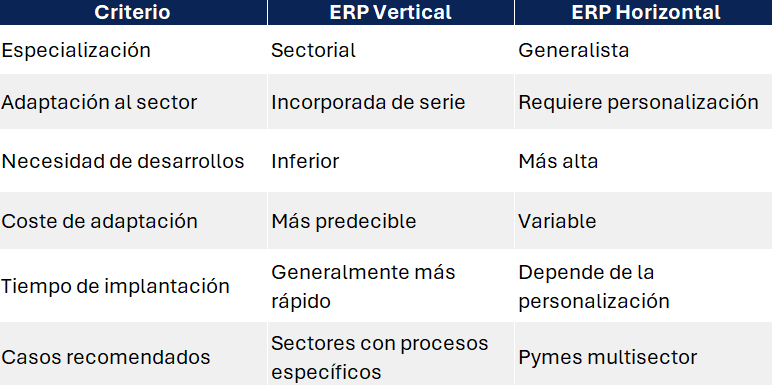
How to choose between a horizontal ERP and a vertical ERP
Before deciding, consider:
- Level of specialization of your processes.
- Operational, legal, or technical requirements of the sector.
- Actual volume of customizations required.
- Total cost of ownership (TCO).
- Future scalability.
If you work in an industry with defined processes, vertical ERP tends to provide more value.
If your company operates in a multi-sector environment or has general needs, horizontal ERP offers greater flexibility.
Solmicro ERP solutions
Solmicro has the most comprehensive catalog of vertical and horizontal ERP programs on the market, including vertical tools developed for a wide range of sectors: industry, automotive, engineering, machinery rental, wine, agriculture, construction, installation, distribution, and services. We also offer a horizontal ERP solution, Solmicro ERP 6, a flexible, adaptable, and modern tool that you can customize to suit your company's needs.
We want to be your technology partner. If you would like more information about Solmicro's ERP systems, contact us and we will advise you on how to implement the most suitable tool for your company.